Dal bhat power
Walking toward Everest base camp at thirteen, and the man who passed me with a refrigerator on his back.
By Roman BoschettoWhen I was 13, I flew into what is often called the most dangerous airport in the world. The day before we landed, a plane taking off there had crashed into a parked helicopter and killed three people.
The airport is Lukla, in Nepal, at 2,860 metres. Its runway is 527 metres long, about a sixth of a normal one, and it is built on a slope. One end is a cliff. The other end is a mountain. A pilot gets one attempt.
Lukla is where the walk to Everest base camp begins. The trail runs about 65 kilometres and climbs to 5,364 metres. It takes more than a week to go up, because the body needs time to adjust. At base camp the air holds about half the oxygen it does at sea level.
The guides called my father Papa. My brothers and I called him that, so they assumed it was his name, and nobody corrected them. They still call him Papa.
One of our guides was Lakpa Sherpa. He was strong, he was kind, and he had a line he said every day:
"Dal bhat power, 24 hour. Two weeks no shower, you smell like a flower."
Dal bhat is rice and lentils. We ate it every day. The first day it was the best thing I had ever tasted. After that it was just fuel, and Lakpa's line was the only thing that made it funny.
I slept in small stone houses with my brothers. The higher we climbed, the worse the beds got and the colder the nights were. But the air was clean and every morning the view was better than the one before.
The walking was hard in a way I did not expect. It was not the steepness. It was the repetition: rock, dust, another hill, the same step thousands of times, with less air each day. On the longest day we walked for eight hours. Many times I wanted to stop.
What kept me going was small. I wanted to see what was around the next corner. Then the next mountain behind the hill we were on. I never thought about the end of the trail. I only thought about the next thing I could see.
Some of it scared me. We crossed long, narrow bridges hung high over rivers, and they moved when you walked on them.
Then, on the trail, a man passed us with a refrigerator on his back.
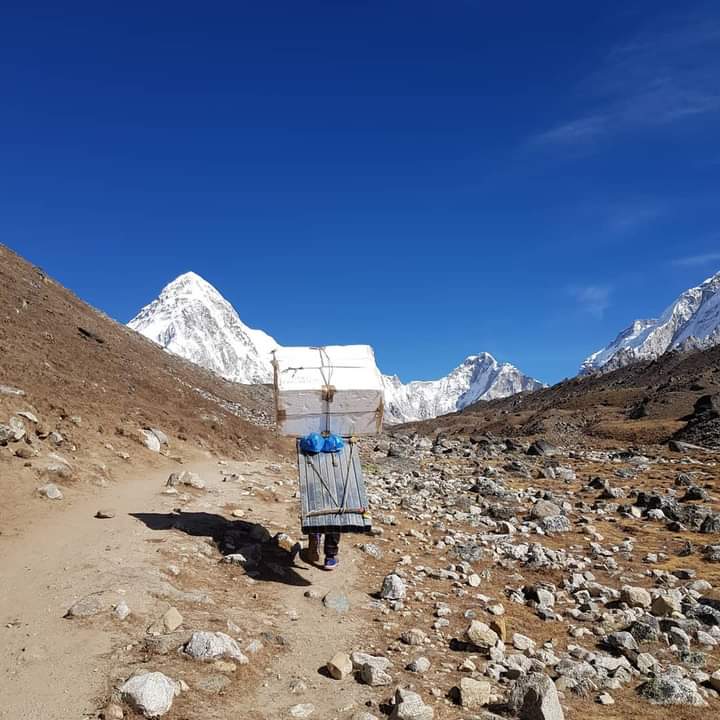
It was a white box bigger than he was, tied to a wooden frame. He was walking the same path I was struggling on with a small backpack, in the same thin air, and he was not stopping.
He was not unusual. There are no roads above Lukla, so almost everything in those villages arrives on someone's back or on a yak. Researchers who weighed porters on this route found that the men carried on average 93% of their own body weight, and one in five carried more than 125%.
I think about him often. Whenever I want to complain about something, I remember that somebody carried a fridge up that trail. I have no right to.
The Lukla accident was on 14 April 2019. The porter figures are from Bastien and colleagues, "Energetics of load carrying in Nepalese porters", Science, 2005.