Hardcap
An investment committee for a portfolio of one.
Open the live demo →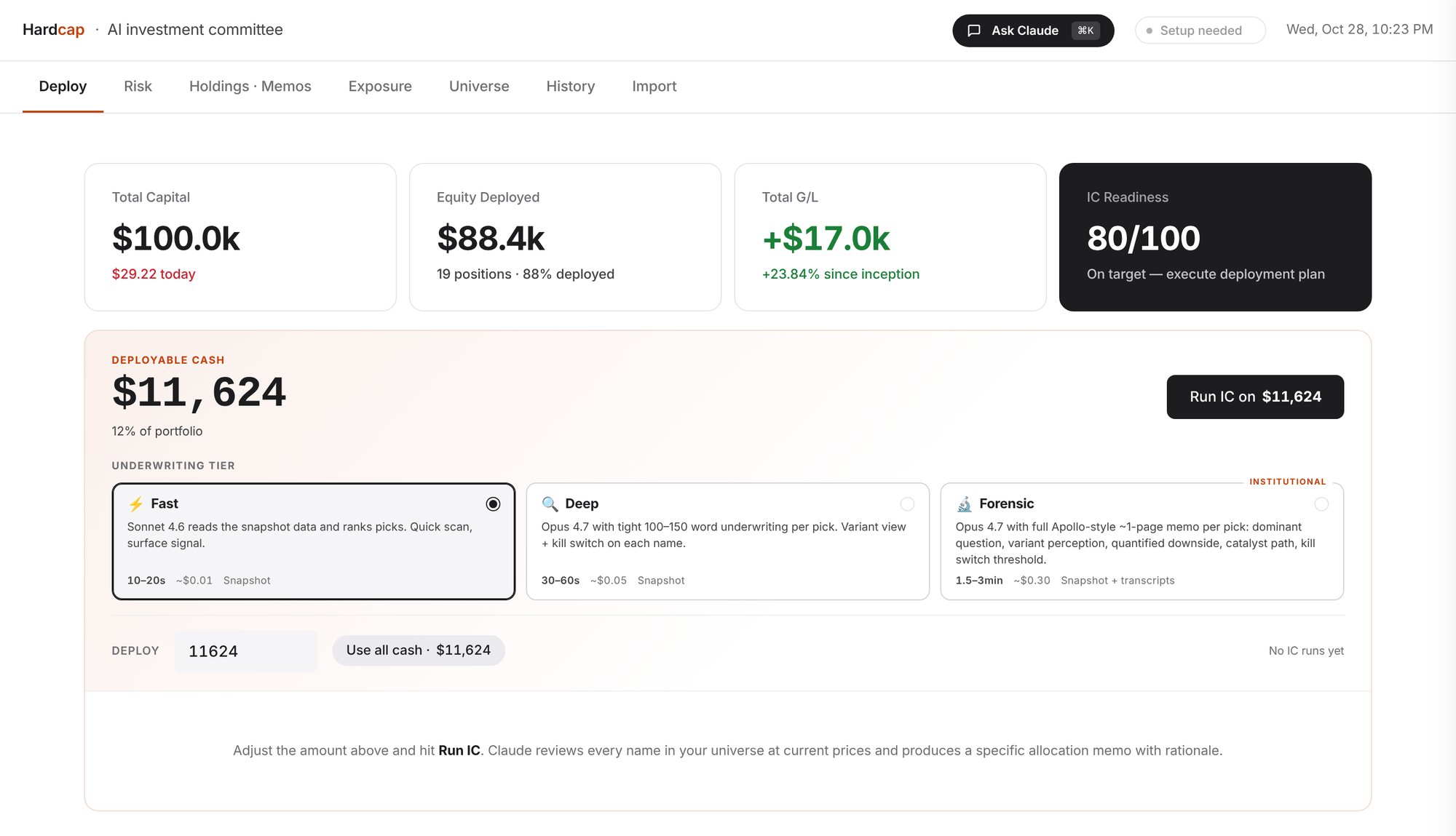
A professional investor has a risk team and a committee that can say no. An individual has a brokerage app that says yes to everything.
I built Hardcap to be the part that says no. It holds me to my own rules before I put money to work.
It is one file that runs in my browser. My positions and theses are saved there, not on a server.
It decides where new money goes
When I have cash to invest, I type in the amount and Hardcap reviews every company on my watchlist at today's prices. It comes back with a specific plan: what to buy, how many shares, and why.
I can choose how hard it thinks. Fast ranks the candidates in about fifteen seconds. Deep writes a short case for each one. Forensic reads the last four earnings calls and writes a full page per company: the question that matters most, where I differ from the market, how much I could lose, and what has to happen next.
Every recommendation comes with a kill switch: the one number that, if it moves past a set level, means I am wrong and should sell.
It enforces my rules
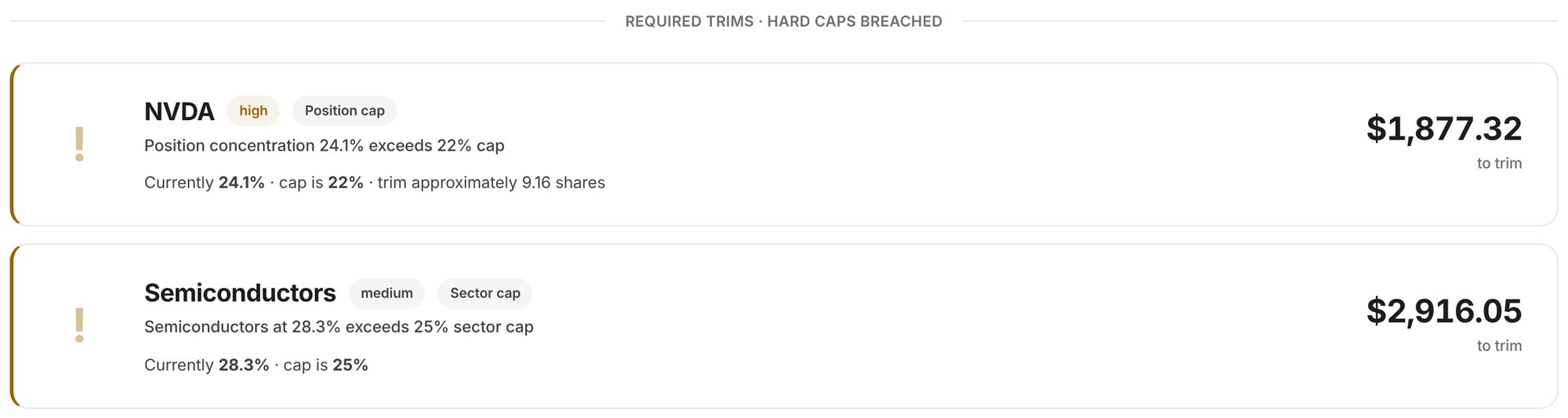
I set the rules once, when I was calm. No single company above 22% of the portfolio. Energy at 25 to 30%, semiconductors at 20 to 25%, alternative asset managers at 15 to 20%.
Hardcap checks the portfolio against them every time I open it. When a position has grown past its limit, it does not say "consider rebalancing." It says how many shares to sell and how many dollars that is.
It asks what could go wrong
The risk engine runs the portfolio through seven scenarios and ranks them from worst to least bad: oil falling to $50, a pause in AI spending, a crisis over Taiwan, interest rates jumping two points, a wave of private credit defaults, a 20% market drop, and a crypto crash.
For each one it shows what I would lose in dollars, which holdings would do the damage, and which single factor I am most exposed to.
It keeps a memo on everything I own
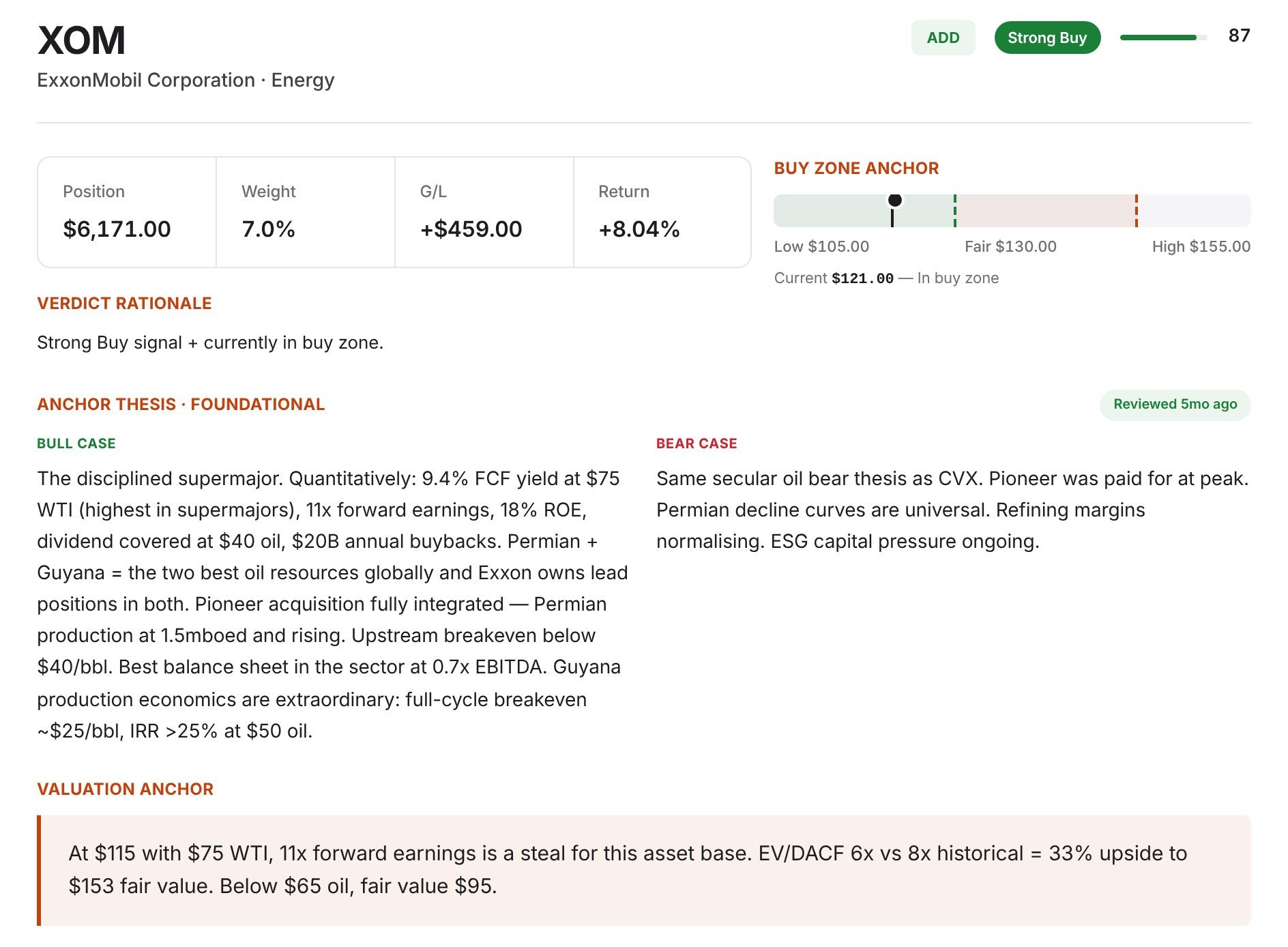
Each holding has a written thesis, a conviction score out of 100, and a buy zone: the price range where I would add, and the price where it stops being a bargain. Each one also records what would change my mind.
If I cannot write the memo, I should not own the stock.
It fills the gaps
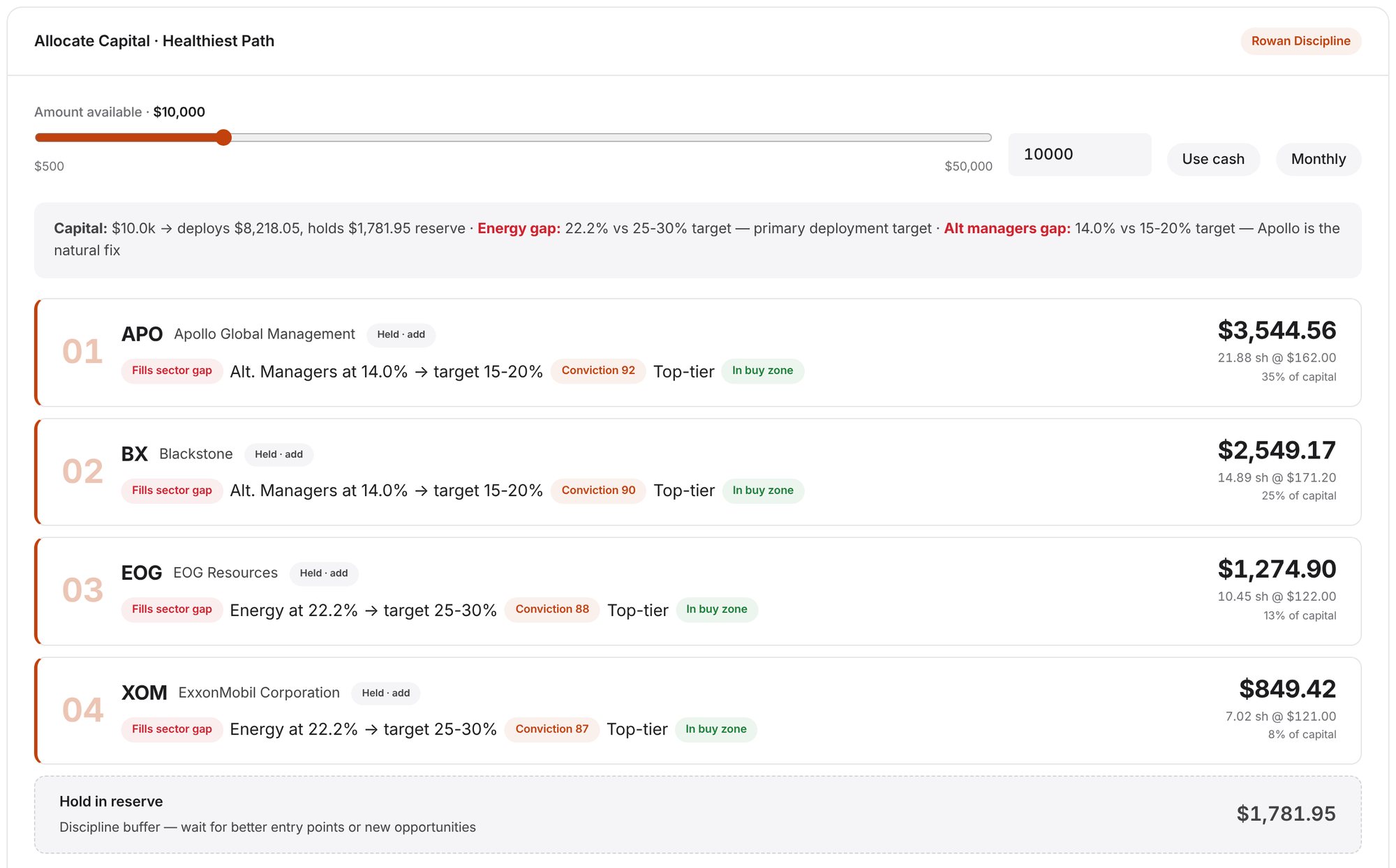
Hardcap compares what I hold with what I said I wanted to hold, sector by sector. Then it directs new money to the largest gap first, picking the highest-conviction company that is inside its buy zone.
How it is built
Hardcap is a single HTML file written in plain JavaScript, with no framework and no server. I built it with Claude Code. I download a CSV from my brokerage, drop it in, and everything updates: prices, weights, gains, exposure and the plan.
Live quotes come through a small Cloudflare Worker that I wrote to keep my data key private. The research and the chat use Claude. Positions, history and theses are stored only in my browser, and I can export all of it as one backup file.
I started it in August 2025 and I use it every time I invest.
Think I have this wrong, or want to talk it through? Email me or find me on LinkedIn.